
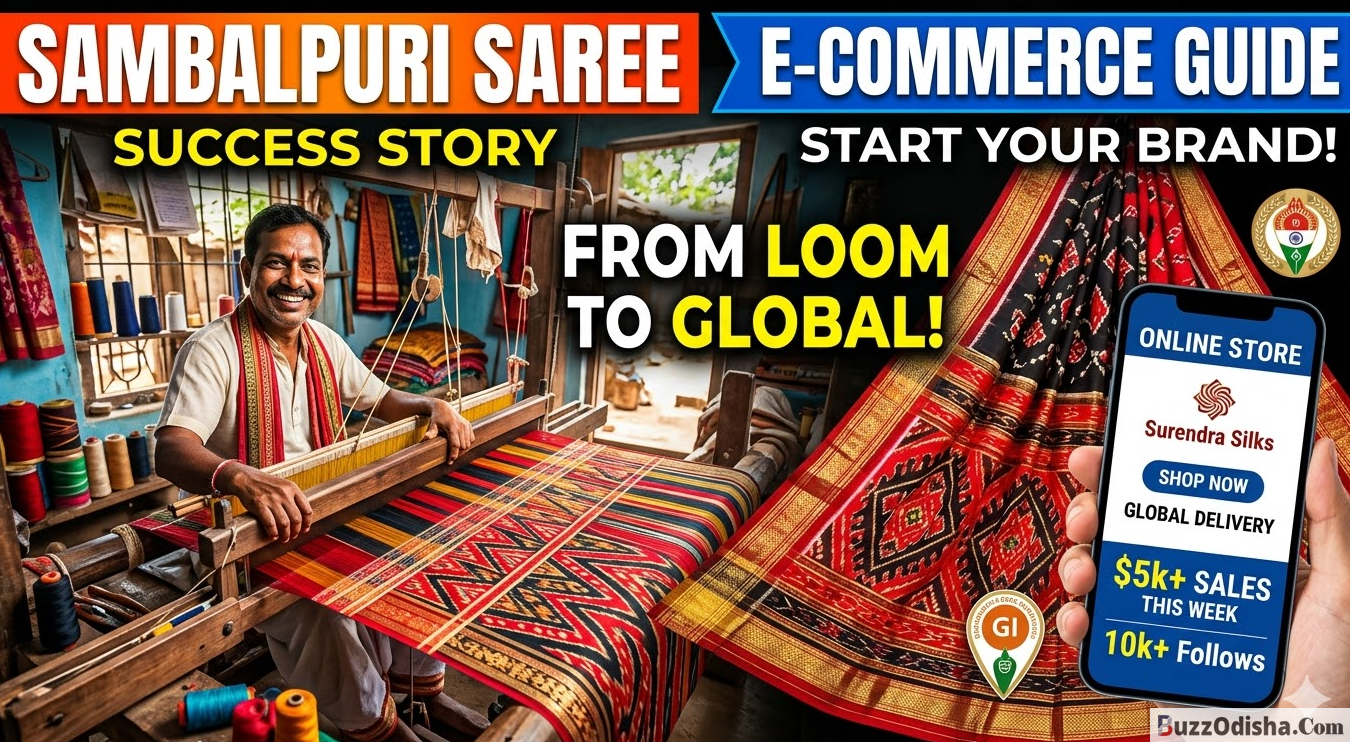
Introduction: The Golden Thread of Odisha’s Economy
Odisha’s textile heritage is not merely a craft; it is a rhythmic heartbeat found in the looms of Bargarh, Sonepur, and Sambalpur. The Sambalpuri Saree, distinguished by its intricate Baandha (Ikkat) tie-dye technique, has transcended its rural origins to become a global fashion statement.
With a Geographical Indication (GI) tag and increasing demand in international markets like the US, UK, and UAE, the Sambalpuri saree industry is no longer just a tradition—it is a high-growth business opportunity. Whether you are a culture enthusiast or an aspiring entrepreneur, understanding this ecosystem is the key to unlocking Odisha’s “Purple Ocean” market.
The Business of Sambalpuri Saree
The uniqueness of a Sambalpuri saree lies in its double ikkat process, where both the warp and weft threads are dyed before weaving. This creates a reversible pattern that never loses its vibrancy.
Market Demand & Potential
-
Local Dominance: In Odisha, Sambalpuri attire is the gold standard for weddings, festivals (Nuakhai, Rath Yatra), and formal wear.
-
Global Export: The “Boita Bandana” motifs and “Shankha-Chakra” designs have gained massive traction among the Indian diaspora.
-
The “Slow Fashion” Trend: Modern consumers are moving away from factory-made polyester and toward sustainable, hand-woven fabrics, positioning Sambalpuri sarees as a premium luxury item.
Challenges in the Industry
Despite the demand, weavers often face middleman exploitation, high costs of raw silk/cotton, and a lack of direct digital market access. This gap is exactly where a modern e-commerce brand can thrive.
The Master of Warp and Weft – A Weaver’s Journey
The Biography of Surendra Meher
In the dusty, rhythmic lanes of Barpali, a small village in Bargarh district, Surendra Meher grew up to the sound of “clack-clack” from his father’s wooden loom.
The Early Struggles:
Born into a family of traditional weavers, Surendra dropped out of school early to support the household. In the 1990s, the family survived on meager wages from local traders who bought their masterpieces for a pittance and sold them in cities for five times the price.
The Turning Point:
Surendra realized that “tradition without innovation is stagnation.” He began experimenting with contemporary colors—pastels and neons—moving away from the traditional maroon and black. He also introduced motifs inspired by Odisha’s wildlife and the Konark Sun Temple, making his sarees “wearable art.”
The Path to Success:
His breakthrough came when he showcased his work at the Toshali National Crafts Mela. A boutique owner from Mumbai noticed his unique “Double Ikkat” landscape saree. Today, Surendra operates a cluster of 50 looms, provides employment to 120 local artisans, and exports his “Surendra Silks” brand to four countries. He credits his $50,000 (₹40+ Lakh) annual turnover to one thing: Direct-to-Consumer (D2C) branding.
Video by Doordarshan Sambalpur – Kathare Kathare Eka Sakshatkar Santha Kabir Puraskar Prapta Surendra Meher Nka Saha
Starting Your E-commerce Brand in Odisha
If Surendra’s story inspires you, the barrier to entry is lower than ever thanks to digital infrastructure. Here is your 2026 roadmap:
1. Market Research & Niche Selection
Don’t just sell “sarees.” Specialize in Sambalpuri Corporate Wear, Bridal Ikkat, or Sustainable Home Decor (curtains/cushions).
2. Ethical Sourcing
-
Direct from Clusters: Visit Bargarh, Sonepur, or Nuapatna.
-
SHG Collaborations: Partner with Women’s Self-Help Groups (Mission Shakti) to ensure fair wages and authentic products.
3. Branding & Platform Setup
-
The Name: Choose a name that resonates with Odia heritage (e.g., BandhaKala, UtkalaLooms).
-
Platform: Use Shopify for a professional store or Instagram Shopping for a low-cost start.
-
Visuals: High-definition photography is non-negotiable. Use natural lighting to showcase the “bleeding” effect of the Ikkat.
4. Logistics in Odisha
-
Hyper-local: Use Mo Bus or local couriers for Cuttack-Bhubaneswar deliveries.
-
National/International: Partner with Shiprocket or Delhivery, which have strong hubs in Jharsuguda and Bhubaneswar.
5. Digital Marketing (The SEO Secret)
-
Content: Write blogs about “How to identify an original Sambalpuri Saree” to build trust.
-
Social Media: Use Instagram Reels to show the “Making of the Saree”—the dyeing process is visually stunning and viral-ready.
Also Check – High-Salary Skills in Odisha: Why Cloud and Cybersecurity Lead the Market
Monetization & Growth Strategy
Scaling requires more than just selling one saree at a time.
-
Subscription Models: Monthly “Handloom Boxes” for collectors.
-
Government Support: Apply for the PMEGP (Prime Minister’s Employment Generation Programme) or the Odisha MSME Development Policy for subsidies up to 25%.
-
B2B Exports: Register with the Handloom Export Promotion Council (HEPC) to attend international trade fairs.
Conclusion: The Future is Woven
The Sambalpuri saree is more than a 5.5-meter fabric; it is a canvas of Odisha’s soul. As digital literacy penetrates our weaving clusters, the bridge between the rural loom and the global wardrobe is finally being built. Whether you are a weaver like Surendra or a digital entrepreneur, the opportunity to scale Odisha’s heritage is now.